


If a brand searched your name on Google right now, would they find something that makes them want to work with you, or nothing at all?
In this post, I’m breaking down exactly what brands see when they look you up, plus the steps to make sure that your Google presence is working for you.
Make sure to follow @GoogleforCreators on Instagram and YouTube for more creator updates directly from Google.
Did you know that brands are going to search for your name on Google? And how you show up on Google matters. Everyone talks about platform-specific tips and tricks for growing a personal brand, but no one is talking about how Google can also have a huge impact on your brand as a creator, no matter what platform you’re on.
In this blog post, you’re going to learn:
- 2 huge benefits for anyone who makes their brand more visible on Google
- 3 quick tips you can implement to start improving your presence on Google
- And at the very end, I’ll show you the POWER of Google and how it has brought my channel over 150,000+ views so far this year.
As always, if you’d prefer to watch instead of read, click the video below. Alright, let’s dive in.
DISCLAIMER: Links included in this post might be affiliate links. If you purchase a product or service with the links that I provide, I may receive a small commission. There is no additional charge to you! Thank you for supporting me so I can continue to provide you with free content each week on my blog and on my YouTube channel!
The 2 Benefits of Improving Your Visibility on Google
Let’s first talk about the two main benefits of improving your visibility on Google:
- Being able to leverage Brand Deals
- Attracting an Audience (or content discoverability)
Now let’s talk about each of these and how they relate to Google. We’ll start with one of my favorite topics: brand deals.
If you’re new to the Creator world, there are a few common ways that brand deals happen. You can find brand collaborations on specific platforms that connect brands and Creators, pitch brands directly, or be discovered by brands and have them reach out to you.
This last one is the goal for most creators. It feels like magic. I remember the first time a brand reached out to me; in my head I was thinking… “oh my gosh, I’ve made it.”
So how are brands finding creators? Well, each brand is different. Some might be:
- Searching hashtags or keywords on Instagram or TikTok
- Watching or discovering your content on YouTube
- Finding you on a 3rd party platform where you have a profile (platforms like Aspire and Cohely)
- Getting a referral from another brand or creator
Your goal as a content creator is to be showing up in the right places, with the right positioning.
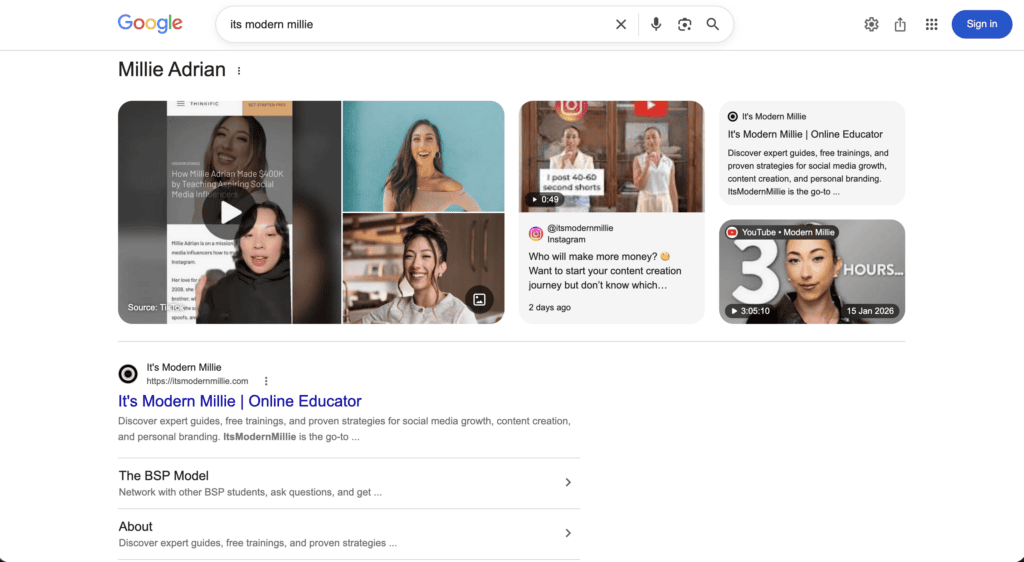
Because when brands discover you, the next step most of them do is jump to Google and type in your name. I mean, my team and I do the same thing to brands! When a brand reaches out, we go straight to Google to look them up.
This is where your Google presence matters, and why I’ve been really excited to make this content to specifically talk about Google’s new Search profile feature for Creators.
If you want to see how this works, you can watch me walk you through it in this YouTube video (just skip ahead to 2:50)
Why Your Google Presence Matters
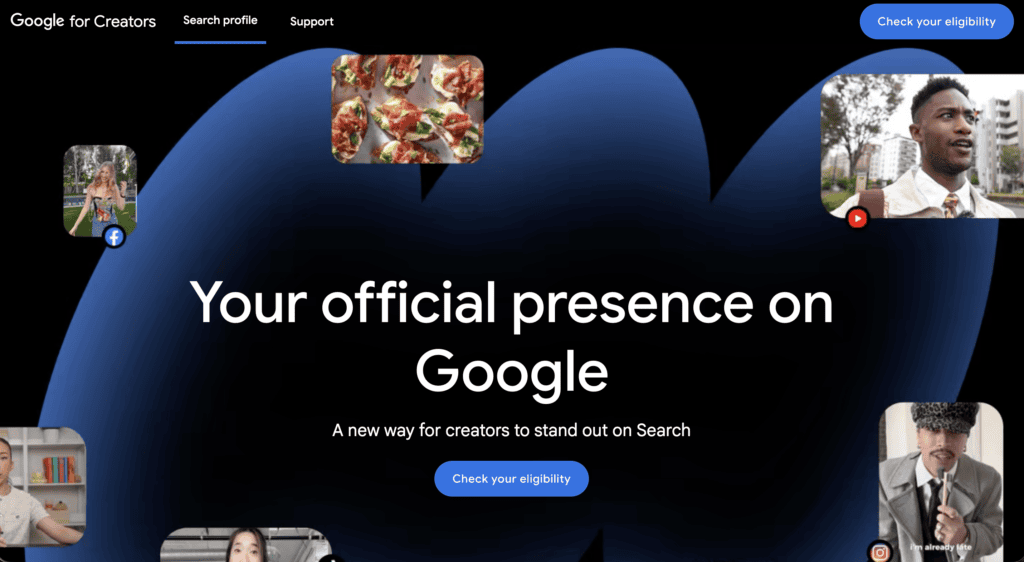
What I like about Google’s new “Search Profile” for Creators is that it gives us a more centralized and customizable way to shape what people see when they search for you online. Instead of spreading your information across multiple platforms and links, your Search Profile brings everything together in one place.
It includes your socials, content, links, bio, and even pinned posts that best represent your brand and the content you create. This makes it easy for brands to learn more about you when they quickly search your name.
And what’s really cool is how customizable it is. You can personalize your name, profile photo, background image, pinned posts, and more, so it actually feels aligned with your brand and your personality.
Search Profile vs Your Presence on Google Search
I love the features in the new Search Profile, but it’s important to know that this is still separate from your presence on Google Search (or the Knowledge Panel). For example, search results pull information from sources across the internet.
Search Results are not customizable, and you can’t fully control what appears in your ‘Knowledge Panel.’ But you can control your Search Profile.
I love this because it lets you create a more polished, official presence on Google, which can be especially helpful when brands are researching creators for potential partnerships.
If a brand looks you up on Google and can quickly get a clear sense of who you are and what you create, that first impression feels more intentional and professional.
The Search Profile centralizes your online presence into an easy-to-share page, instead of requiring people to click across multiple platforms to learn more about you. And I’ll talk about another way you can use the ‘Share’ feature on these pages in your brand deals.
Once your profile is set up, brands searching for your creator name may start to see a more polished and personalized overview of your content and online presence directly on Google.
Who’s Eligible for a Search Profile
A quick note on eligibility: currently, creators qualify if they have a public profile with at least 100,000 followers on Instagram, YouTube, or X. If TikTok is your only platform, the follower requirement is 300,000 followers.
If you’re eligible and want to set yours up, you can head to creators.google/profile to check eligibility and customize your own search profile. Make sure to follow @GoogleforCreators on Instagram and YouTube for more creator updates from Google.
Set this up as soon as you’re eligible, because as a creator, you are running a business, and this is a powerful way to help your business show up more professionally online.
Landing Brand Deals Through Pitching
Earlier in this post, I talked about the various ways you can land brand deals as a creator, including pitching brands directly. I get asked about this a lot, so I want to leave you with some tips to get started.
You can pitch to brands no matter how many followers you have.
A lot of creators wait until they hit a specific threshold (normally people feel like they need 10,000 followers) before they start pitching, and this isn’t the case–especially in 2026. I have helped so many students under 10,000 land brand deals through pitching.
The things that brands care about more than your follower numbers are the parallels between your brand and theirs. This could be things like:
- Do you and the brand have a similar target audience?
- Will your followers genuinely be interested in that brand or their products?
- Are your followers engaged and supportive of your content?
Consistency Matters
Another thing brands look for is your posting schedule and consistency. A lot of brands aren’t going to want to work with creators who post and ghost, so they might look at:
- Your online presence
- How often you’re posting
- And whether you’ve been consistently posting for a long time
When you find a brand that you want to pitch to, make sure to steal my pitch template. I shared a screenshot of it in this video on this topic; you can watch that here (skip ahead to 8:22 for the exact pitch template that I use).
Your goal with this pitch isn’t to land a brand deal or get something for free. It’s to connect with a brand. Don’t pitch with a selfish mindset of what this brand can give to me; instead, pitch with the mindset that you’re helping that brand and, by working together, you’ll both be able to grow.
If you want my free brand pitch templates, you can download those here.
Common Pitching Mistake
A common mistake that I see creators make when they’re pitching a brand is attaching their media kit. You might think this is the best way to share the details of your online presence, but I prefer incorporating your Google Search Profile.
I’ll use the easy-to-share page as a link directly in my pitch template, and this can actually help you land in the right inbox. Something I think a lot of people don’t know is that attaching a file to an email can risk your email getting sent to someone’s spam folder.
But hyperlinking in an email is just fine. If you don’t meet the threshold for Google Search Profile pages, you can also share your media kit as a ‘View-Only’ link directly from Canva.
However, when a brand sees that you’ve shared a link from Google, it gives them even more reason to trust the information there, because Google is already such a trusted resource.
Let’s talk about the second benefit of making your brand more visible on Google: attracting a new audience and improving content discoverability. This is YOU, your content, and your profiles, all of which can be discovered on Google.
Google is the ultimate search engine, and anyone searching for anything on Google can come across any content that’s been posted online, regardless of what platform the content was shared on.
Being Discoverable on Google
These days, if you go to Google and type in a search, the results are so much more than just websites and blog posts. You’ll also get YouTube videos, Instagram Reels, TikTok videos, and all sorts of search results across platforms.
This opens Google as a new platform for content discoverability. So now, instead of only having people find you on Instagram, people can discover your Instagram content on Google. Now you can leverage Google results to hit two birds with one stone.
This is where a lot of people underestimate the power and importance of SEO. I know that SEO can be overwhelming. When I first started my creator journey, I would completely zone out when people started talking about SEO. I overcomplicated it in my head and thought it was a really advanced strategy that only certain people could figure out.
When I finally leaned into SEO, I realized it was so much easier than I’d made it out to be.

Search Engine Optimization
For those of you who don’t know, SEO stands for Search Engine Optimization. Let’s forget the complexities, and I’ll break this down simply for content creators.
SEO is simply the act of creating content that could be discovered on search engines. And these days, everything is essentially a search engine. There are the obvious ones, like Google or Pinterest, but Instagram, YouTube, and TikTok are all becoming search engines.
So when you create content, you do it with intent and the hope that it will get discovered. You don’t have to do this with every single piece of content, but it should be a part of your content strategy.
The easiest way to do this is:
- Go to whatever platform you are trying to grow on
- Type one of your content pillars into the search bar
- Don’t press search
- See what the suggested search results are under that term
- Make videos using those phrases
The phrases suggested to you are the phrases other users are searching for on that platform. You can take it a step further by looking up your content pillar on Google, then doing the same thing and creating content around those search terms.
Google can be so powerful for content creators, especially when you lean into the ways to leverage it for yourself.

3 Ways You Can Start Optimizing Your Google Strategies
1. Audit What’s Already Out There
Look yourself up on Google right now (make sure you’re in incognito mode and logged out). See what shows up on the first page of Google search results. This is your chance to land that first impression. Audit what you see.
- Do your social media profiles show up?
- Is your website front and center?
Think about how you can optimize that first impression by auditing your presence on Google. Make sure everything looks good, and if you’re not seeing many results, lean into what I am going to share next.
2. Get Your Name in Text on the Internet (and make sure it’s consistent)
If you don’t see much when you Google yourself, that’s OK. There are things you can do to change that. Any platform you own should rank for your name or brand name.
This is where you can go back to your profiles and make sure everything uses the same name across platforms. A consistent brand name is one of the easiest ways to bulk up your Google search results.
Search engines index text, so you need to make sure your name appears in articles, guest posts, podcast show notes, and collaboration video descriptions. Even a single interview or guest feature can help create a searchable footprint.
“Being featured somewhere” signals to Google (and brands) that you’re an authority on that topic.
3. Claim and optimize your searchable assets
What are your searchable assets? Your website, blog, Substack, or link-in-bio page. In any of those places, make sure that your name and information are consistent. If you have your Google Search Profile, make sure to link all of your social accounts, add your website and relevant links, complete and edit your “About” section, and upload a profile picture.
If you have a website, make sure you have an About page and a profile picture, and add a short “about you” blurb to your blog posts to remind people and Google who you are.
Those are just a few ways you can strengthen your presence on Google, and now I want to show you the real power of Google and how it’s helped me grow this year.
Google is very different from social media. Where on Instagram you might want to go viral within 24 hours, Google is the long game. It’s looking at how you’ve shown up online for the last year, two years, and even more than that.
Optimizing for Google isn’t about going viral. It’s about content discoverability and building your presence over time. And as you can see here, Google actually contributed over 150,000 views to my YouTube Channel alone (just this year).

That is just this year, so far. That doesn’t include people discovering me on TikTok, Instagram, or my website. And if you want to look at my lifetime stats, I’ve gotten almost 1 million views on my YouTube channel from Google alone.
Being consistent really pays off.
I’d love to know what you think about this content. Let me know in the comments below, especially if you have any questions about building a Google presence for yourself.
Thank you so much for being here. If you’d like to learn more about SEO, I recommend reading this post next.
I’ll see you in the next one. Follow your joy!





Be the first to comment