


I’ve worked with hundreds of brands, making over $500,000 from brand collaborations. Today, I’m sharing 7 lessons that I’ve learned along the way.
Over the past 7 years, I’ve worked with hundreds of brands, making over $500,000 from brand collaborations. I’ve learned a lot about working with brands from each of these collaborations. Today I want to share those lessons with you, to help you along your content creation and brand collaboration journey.
So in this post, I’m sharing the 7 biggest lessons I’ve learned from the last 7 years of doing brand collaborations.
Some of the things that I’ll be talking about are:
- How to get on a brands radar
- Ways you can get paid even MORE from your content
- Best practices around pitching
- Relationship building
- And so much more
As always, if you’d prefer to watch instead of read, you can click the video below. Now, let’s jump right in.
DISCLAIMER: Links included in this post might be affiliate links. If you purchase a product or service with the links that I provide, I may receive a small commission. There is no additional charge to you! Thank you for supporting me so I can continue to provide you with free content each week on my blog and on my YouTube channel!
Lesson 1: Your Profile is Your Portfolio
If you want to be on a brand’s radar, you need to treat your social media profile like your resume and portfolio. Imagine that it’s the first thing brands are going to see, when deciding whether or not to work with you.
In other words, start creating content as though you’re already working with brands. And make sure to optimize your bio for future collaborations.
This can help you in a few different ways:
- It helps brands see what collaboration content looks like with you (your niche, the type of content you create, how often you create)
- Your social media profile is a great way for you to build a relationship with a brand (and increase your own engagement in that brand’s world)
- You can increase your discoverability (especially on ‘brand search’ platforms)
So what can you do now?
Find the products and brands that you already know and love, and start making content. Start creating one post per week, as if it were a brand collaboration. This helps you build the muscle of creating for brands. Plus it shows brands landing on your profile, what kind of content you could create for them.
You can also speak directly to your target audience, and add your email to your bio. When you speak directly to your target audience in your bio, you’re not only telling new followers why they should follow you, but you’re also telling brands who your audience is and if that audience aligns with their audience, you’ll have a much more successful collaboration.
Adding your email to your bio is a strategy that I always teach for creators who want to get more PR. If that’s something you’re interested in, I recommend reading this post next.

Lesson 2: Every Collaboration is Different (and should be charged that way)
The second lesson that I’ve learned from brand collaborations is that no two collaborations are the same–and on that note, I don’t think I’ve ever charged the exact same price for any two collaborations. The price I charge depends on what each specific brand is looking for.
While a lot of creators have rate cards, I personally don’t use one. I do have a base rate that my manager and I know, and then anything else is added onto that rate.
So what could you charge extra for in a brand collaboration?
First, before you ever say a number to a brand, get as much detail as possible about the partnership. Here are some of the things that you want to think about and ask:
- What deliverables they’re looking for
- The timeline they want everything done by
- Usage rights
- And exclusivity
Once you know all of that information, then you can send the brand your rates.
If you want to learn more about how much to price a collaboration, I’ve created posts on Instagram, TikTok and YouTube collaborations. Here’s the link to my TikTok Collaborations Guide, my Instagram Collaborations Guide, and my YouTube Collaborations Guide.
There are so many additional things that you can change extra for in collaborations that I don’t see a lot of people talking about. And all of these little things are exactly WHY each collaboration is going to be priced differently.
For example, brands might want raw footage, some might want you to repost to TT and YT Shorts and others might want 1 reel but they’ll want you to create it in multiple formats (like 1:1, 4:5 and 9:16).
Another thing I’m seeing brands ask for more these days is a Comment to DM Automation which shares their product or link directly to your audience’s DMs. This is 100% something that you can charge extra for, and something that you can set up with Manychat.
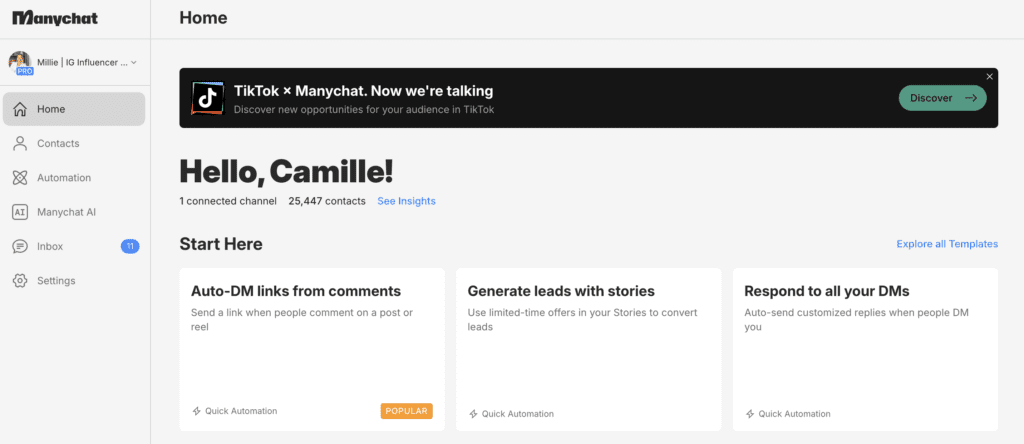
Manychat in Collaborations
Before Manychat, a collaboration might ask you to use a CTA asking your audience to ‘click the link in your bio’ or simply to go to the brand’s page or website. There was also a time when you could charge a brand extra to use the link in your Story.
But now, brands are asking for DM automations to be set up. And they’re willing to pay more if you’re able to do that.
When you include a Manychat Automation in your brand collaboration, you can add a CTA like “comment the word BANANA and I’ll send you the link to try Banana Coffee for yourself.” Boom. Manychat automatically replies and sends them a DM with the product you’re talking about.
Being able to send YOUR audience to THEIR products is a gold mine for brands. But I’ve also seen these DM automations boost my videos as well, making them a win-win for brand collaborations.
People commenting on your post boosts your engagement, especially when every reply gets another reply from you. This doubles the amount of comments on your post without you having to do a thing.
I’ve been using Manychat since 2022 and they’ve truly helped me create a reliable system behind my own content. Once I hit publish, Manychat handles the follow-up by responding to comments, DMs and Story Replies. I can use Manychat to guide people to the right resource, I can answer common questions and I can tell people exactly what they should take action on next.
I’ve used Manychat to grow my account and nurture my audience and I love that I can now boost my own engagement, make brand collaborations more beneficial and make a little extra money from brands with the help of Manychat.
Lastly, Manychat is an official Meta Business Partner, so it’s built specifically to work with Meta’s platforms. If you want to give Manychat Pro a try, you can get 30 days free when you sign up here and use the code MODERNMILLIE.
A huge thank you to Manychat for sponsoring this content.
Now, let’s talk about another way to start getting in front of brands for collaborations, using third-party platforms.

Lesson 3: Utilize 3rd Party Platforms
A big lesson that I learned when I started working with brands was basically the value of 3rd party platforms. These platforms are literally like LinkedIn or Indeed, but for influencers to find collaborations. The first handful or free and paid brand collaborations that I ever landed were on platforms like:
- Cohely
- Popular Pays
- Obviously
- Aspire IQ
- Fohr
You can get started by simply making a profile on each of these websites and applying to work on campaigns that align with your brand values and audience. The whole point of these platforms is to connect you with brands that are currently running influencer marketing campaigns.
I know there is some hesitancy around 3rd party platforms and I’ve even seen some creators scoff at them, but I actually believe that they can be a great way to gain experience and start building relationships with brands.

Lesson 4: There is Power in ‘No’
The fourth lesson that I’ve learned from brand collaborations is probably one of the most important ones. And I’m going to start by telling you a story of a time I said yes to a brand…when I definitely should have said no. Then I’ll you the story of a time I did say no to a brand, and how that ended up bringing me even more opportunity.
One of the first ever paid brand collaborations that I did…was with a product that I had never used. It was a product I didn’t want to use…It was a skinny tea.
I know. Believe me, I know. This was a long time again and I should have never said yes. But I did, so let’s talk about it. I think they offered to pay me $500, which would have been the most a brand had ever offered to pay me. So while I felt, in my gut, like I shouldn’t be working with them, it was also money and at the time, I went with that.
Looking back at that content and collaboration is so cringey. Not just because I don’t believe in the product, but also because they ended up being so strict. I had no creative freedom, they told me exactly how I should pose, what the picture should look like, even how I should hold the tea.
They didn’t let me be me. It was just an ad. The entire partnership felt inauthenetic and I honestly felt like a sellout. So take it from me, it’s not worth saying yes, if your gut is saying no.
Then there was another time–a collaboration opportunity with a brand that I genuinely loved on a campaign that I would have loved to be a part of… BUT. And there’s a big but here–because the list of content that they wanted from me was insane. If I’m remembering correctly, they wanted:
- 6 YouTube Videos (in one month)
- 30 emails written and scheduled
- 15 short-form videos (in a month)
It was so much work and the promise to me was how much exposure I would get. Because the amount they wanted to pay me was the same that I charged for ONE YouTube Integration.
It hurt to say no. I thought about it for days, but I couldn’t do it. Not only for myself, but for my team. Knowing that I would be putting my team through this stress as well, without additional budget to make it worth the effort. I knew I couldn’t do that, so I said no and they ended up moving on with another creator.
But because I said no, I was able to say yes to a partnership that came in a few days later, that only wanted 2 Reels, but had a budget 4 times higher.
Honestly. When one door closes, another one opens.
You have to listen to your gut, because when you stand up for yourself and when you know what your value is, the universe will respond. That’s why understanding your value and knowing when to say no is such a powerful lesson to learn as a content creator.

Lesson 5: Pitching Can Feel Like a Full-Time Job
There are so many lessons that I’ve learned from pitching. I have sent hundreds of pitches to brands over the past 7 years. And what I’ve learned from pitching boils down to these main truths:
- For every 10 pitches you send, you might get 1 response (and that doesn’t mean it’s going to be a yes)
- Pitching isn’t for landing brand deals, it’s for making connections and planting seeds.
- Following up converts to yes’s more often than not following up
- Pitch with a specific idea in mind (but don’t attach files in your pitches)
When you start pitching brands, instead of saying, “I’d love to collaborate!” Be specific and spend time coming up with an idea that both serves the brand and your audience.
This is what’s going to make you stand out in your pitches. It’s going to be the thing that personalizes the pitch and shows the brand that you genuinely care about their growth and the outcomes of the partnership.
For example, if you’re in the workout or fitness space and you want to work with a brand that sells workout clothing, instead of pointing out the obvious and simply asking the brand to collaborate with you, you could come up with a specific campaign idea that focuses on the brand’s goal and your audience’s interests.
This could be a summer running challenge, featuring their new line of running shoes, or an ‘opt-outside this summer’ campaign with their collection. Think about what the brand is currently doing in their marketing, and match your pitch to their efforts.
Pitching brands should take time, because generic pitches are simply going to get skipped. If you want a brand to say yes, make sure that you’re giving them every reason to.
And if you need help writing your pitch email, download my free email pitch templates here.

Lesson 6: Working With Brands Is More About Building Relationships With People
The most successful brand collaborations that I’ve done haven’t been because the brand was the best fit for my niche. They haven’t been because I and my audience both already loved the brand. They’ve been the most successful because of the relationship that I’ve built with the person from the brand that I’m in contact with.
Show people that you care about them. That you know their human and you’re human too. I don’t mean this to sound vague, but nurturing the relationship with the person on the other end of the email or phone call, can go a long way in seeing success working with that brand.
It’s amazing to work with brands that you love, but it’s even more amazing when you love the PEOPLE behind the brand.
Take the time to treat the person behind the screen like a person, because these connections are the things that make brands want to keep working with you (which of course, helps with income as well).

Lesson 7: The Brand Collab Process Is Running a Business
Managing brand collaborations is a business. This is so important.
The first few brand collaborations that I did, I was far more focused on the content than I was on the relationship building and the professionalism. I didn’t really see the brand as a client of mine. And I didn’t see it as the brand hiring me for a service.
Brand collaborations are their own ecosystem. Brands expect creators to bring professionalism to the table when working with them.
Brands expect you to be on time with deliverables. They expect professionalism, clear communication and organization. And they want communication, don’t just send them the final draft. Let them be in the know and when you treat the entire brand collaboration process like a service you are offering, with clear communication and expectations along the way, it just uplevels the whole experience for you and for the brand.
The more collaborations you’re doing, the more organized you need to be. Things can get complicated and you want to make sure you’re delivering everything on time and efficiently.
For example, in June I had 12 different collaborative pieces of content and that’s why you need to have a system in place to keep everything organized.
If you have any other questions about brand collaborations, drop them in the comments below and I’ll work on part two. Thank you so much for being here. I’ll see you in the next one. Follow your joy, bye!





Be the first to comment